
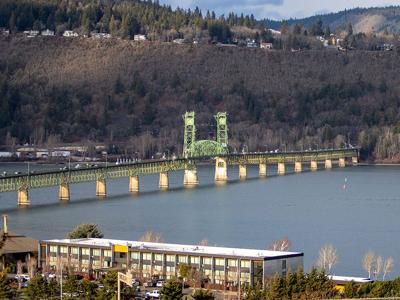
THE GORGE — Although the past two years witnessed key financial milestones that made Hood River Bridge replacement possible, federal funding delays could slow progress, according to information presented at the Hood River–White Salmon Bridge Authority meeting March 23.
Formal contracts are still pending for two grants already awarded, while two anticipated federal resources — a grant and a long-term loan — have yet to be confirmed.
Delays haven’t yet reached critical level, but bridge authority representatives will bring their concerns to Washington, D.C., in April to help keep this $1.12 billion project on track.
“We’re losing our runway quickly,” noted Mike Fox, bridge authority commissioner, in the March 23 meeting. “We’re right up against it.”
During next month’s visit to Congress and the U.S. Department of Transportation, bridge delegates will emphasize progress already made and offer assurances of a successful project — one that’s on time and on budget — if funding falls into place. It would demonstrate how federal, state and local partnerships can help resolve the nation’s myriad infrastructure challenges.
All monies must be in hand by March 2027 at the very latest. Ideally, funding assurance by October 2026 would allow construction materials to be ordered, minimizing supply chain holdups. The project’s engineering firm, Kiewit Construction, would then proceed smoothly from design to construction. Otherwise, separate construction procurement could miss a critical “in-water” period when work can take place in the Columbia next winter without disrupting fisheries.
The estimated project cost of $1.12 billion includes construction, demolition, contingency and projected inflation. Oregon and Washington state grants were fully secured in 2025, with $250 million ($125 million from each state) covering design, engineering, and current administrative costs. Another $20 million is in-hand from several earlier grants.
Meanwhile, two significant federal grants have been awarded but require formal spending contracts. These are a $200 million federal infrastructure grant awarded January 2024 and an $8 million Congressional appropriation, also awarded in 2024 and similarly still pending a contract.
Two other major federal sources are expected but yet to be confirmed: $532 million through the Bridge Investment Program (BIP), which is only available through the current fiscal year, and a US Department of Transportation Infrastructure Finance and Innovation Act (TIFIA) loan. Anticipated at about $105 million, TIFIA will be financed by future bridge tolls. About half of current bridge tolls are already directed to a loan repayment fund now standing at about $9 million. The target fund is $18 million by bridge completion, by which time all toll revenues will be directed to loan payments.
While there are no indications the TIFIA loan is in jeopardy, it’s still a very large, unconfirmed piece in the funding puzzle. TIFIA and all funding sources must be secured before a construction “notice to proceed” is issued.
Federal funding uncertainty isn’t just a local challenge, noted Debbie Smith-Wager, finance director for the Port of Hood River, at the March 17 meeting. Smith-Wager maintains the bridge authority’s accounts leading up to construction. “It’s affecting everybody everywhere — red states, blue states.”
Further, a different timeline could threaten funding already in hand.
For instance, the infrastructure grant awarded in January 2024 (but which still awaits a contract) must be fully “obligated” (committed to expenditure) by September 2027. The grant could expire if that deadline isn’t met.
Of particular urgency is the Bridge Investment Program, a $532 million grant request not yet awarded. Although BIP is a competitive program, the bridge authority can make a strong case for award, noting the $250 million secured from Oregon and Washington, sustainable toll revenues, and a favorable environmental record of decision obtained last fall.
Bridge construction will start in October 2027 — if TIFIA arrives this spring, if BIP is approved, and if the infrastructure and appropriations contracts are formalized — on track for completion in 2031. If any of those dominoes are left standing … well, the April delegation to Washington, DC, will explain just what’s at stake.
In other bridge updates:
- The bridge authority anticipates a formal agreement with Burlington Northern Railroad for north shore construction access. The plan is for a temporary, in-water trestle leading to the shoreline, and a temporary construction access road above the rail line leading down from State Route 14. Three bridge piers will be constructed on land between shoreline and highway.
- High school students from White Salmon, Hood River, Stevenson and The Dalles will be invited to a construction career day May 21 at the Port of Hood River’s waterfront Lot One, organized by the bridge authority to highlight skilled construction jobs.
- About half of the riverbed core borings have been taken to verify a solid foundation for the new bridge piers. (The current bridge piers sit about 60 feet above bedrock on consolidated sand and gravel, presenting a seismic hazard.) A permit is still needed from Washington State’s Department of Natural Resources for remaining borings close to the Washington shoreline.


Commented